William Moorcroft at MacIntyre: The Years That Shaped a Legend (1897–1912)
In 1897, a 24-year-old William Moorcroft walked through the doors of James Macintyre & Co. in Burslem, Staffordshire — and British art pottery would never be the same again.
What began as a designer’s position at one of the Potteries’ established ceramic manufacturers became a 15-year journey of extraordinary artistic growth, international acclaim, and ultimately, an inevitable parting of ways that would give birth to one of the world’s most celebrated pottery names.
A Young Designer With Exceptional Talent
Born in 1872 in Riley Street, Burslem — the very heart of the Potteries — William Moorcroft was steeped in ceramic tradition from birth.
He studied art in Burslem before furthering his education in London and Paris, returning to his hometown with a rare combination of artistic vision and technical knowledge. When Macintyre employed the young Moorcroft as a designer, they could not have imagined how quickly his talent would flourish. Within just one year, this ambitious young man was placed in full charge of the company’s entire art pottery studio — a remarkable rise that signalled great things to come
A Young Designer With Exceptional Talent
Born in 1872 in Riley Street, Burslem — the very heart of the Potteries — William Moorcroft was steeped in ceramic tradition from birth. He studied art in Burslem before furthering his education in London and Paris, returning to his hometown with a rare combination of artistic vision and technical knowledge. When Macintyre employed the young Moorcroft as a designer, they could not have imagined how quickly his talent would flourish. Within just one year, this ambitious young man was placed in full charge of the company’s entire art pottery studio — a remarkable rise that signalled great things to come.
From Aurelian Ware to the Birth of Florian
Moorcroft’s earliest work at Macintyre included designs for the company’s Aurelian Ware range — high-Victorian pottery featuring bold transfer-printed and enamelled decoration in rich reds, blues, and golds. These pieces reflected the taste of the era, but they were merely a prelude to what would become his defining achievement.
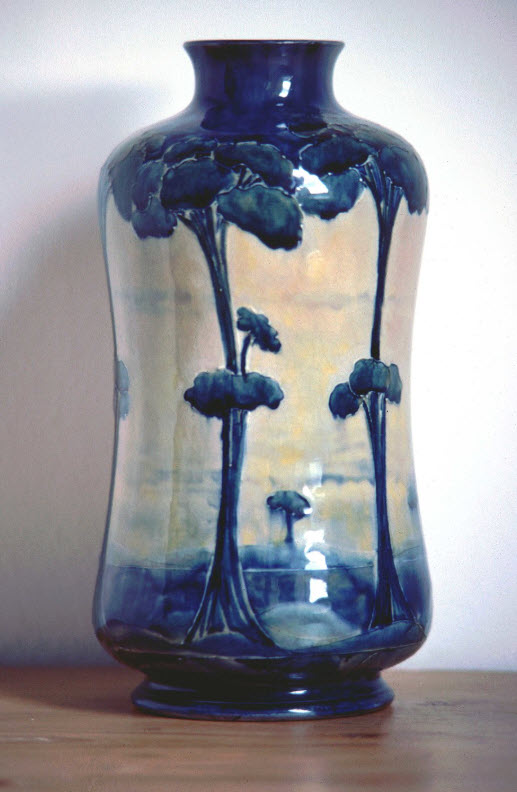
It was the development of Florian Ware that truly announced William Moorcroft’s genius to the world. Breaking away from the transfer-print techniques of Aurelian, Florian Ware was decorated entirely by hand using a labour-intensive process called tubelining — where liquid clay (slip) was trailed onto the surface to create raised outlines, which were then filled with colour and finished with lustrous, translucent glazes. The results were breathtaking: flowing Art Nouveau forms, natural motifs of flowers and foliage, and a brilliance of colour that seemed to glow from within.
Moorcroft also experimented with oriental shapes and developed highly lustred glazes — some of which remained closely guarded trade secrets known only to him. His obsessive attention to quality meant he personally oversaw every stage of production, ensuring each piece met his exacting standards.
International Recognition and the Gold Medal
Florian Ware was an immediate sensation. The flowing designs and jewel-like colours captured the spirit of the Art Nouveau movement and found admirers across Britain and beyond. Then came the ultimate validation: in 1904, William Moorcroft won a gold medal at the St. Louis International Exhibition in the United States — one of the great world fairs of the era. This prestigious award brought international attention not just to Macintyre, but to Moorcroft himself.
Further accolades followed. In 1910, he won another gold medal at the Brussels Exhibition, cementing his reputation as one of the finest art potters of his generation. These triumphs were not accidents — they were the fruits of relentless experimentation, artistic courage, and an unwavering commitment to excellence.
The Personal Touch: Signing His Work
One of William Moorcroft’s most significant — and audacious — decisions during his Macintyre years was to sign his name, or his initials, on nearly every piece of pottery he designed. This was highly unusual at the time. Pottery was typically sold under the factory’s name, with individual designers remaining anonymous. But Moorcroft understood the power of personal identity. His signature transformed each vase, bowl, and jardinière into something more than a factory product — it became a work of art with an artist’s name attached.
This practice brought William Moorcroft enormous personal recognition, but it did little for the Macintyre name. As his fame grew, the tension between the rising star and his employers began to simmer.
Growing Tensions and the Inevitable Split
By the early 1910s, William Moorcroft’s art pottery had become so successful that it overshadowed Macintyre’s other manufacturing activities. The company’s core business was industrial ceramics — electrical insulators, tableware, and utilitarian goods — and supporting an art pottery studio had only ever been a fashionable sideline for prosperous manufacturers. Resentment grew among Moorcroft’s employers as his personal reputation eclipsed the Macintyre brand.
The breaking point came in 1912, when Macintyre informed William Moorcroft that his department would be closed by 30th June 1913. After fifteen years of dedication, innovation, and international triumph, the studio that had brought Macintyre such prestige was being shut down.
But William Moorcroft was not a man to be defeated.
A New Beginning: Marching Across Cobridge Park
Rather than accept the end of his pottery career, Moorcroft took bold action. With financial backing from Liberty & Co. — the famous London department store that had long admired and sold his work — he purchased a site and built his own factory at Sandbach Road, Cobridge, just a short walk from Macintyre’s premises.
In a moment that has become legendary in Potteries history, William Moorcroft marched his workforce across Cobridge Park to the new factory. Macintyre, perhaps recognising the futility of standing in his way, gave Moorcroft their customer list and all his moulds — an act that helped him establish his new venture with a solid foundation.
On 22nd April 1913, W. Moorcroft Ltd was officially incorporated. William was just 41 years old but had already accumulated 16 years of ceramic design experience. He married Florence Lovibond that same year, and the new factory was built in an astonishing ten weeks. Production transferred seamlessly, and the world-famous pottery that still bears his name was born.
The MacIntyre Legacy
The years at Macintyre were formative in every sense. It was here that William Moorcroft honed his craft, developed his signature tubelining technique, created the iconic Florian Ware, and won the international recognition that made his name synonymous with quality art pottery. Without those fifteen years of experimentation, triumph, and growing ambition, there would be no Moorcroft Pottery as we know it today.
When Moorcroft left Macintyre in 1913, he took with him not just his moulds and customers, but the knowledge, skill, and artistic vision that would sustain his pottery for generations. The business flourished, sold through Liberty in London and Tiffany in New York. In 1928, Queen Mary granted him a Royal Warrant as “Potter to the Queen” — a fitting tribute to a man whose talent had outgrown any single employer.
William Moorcroft’s time at Macintyre was not just a chapter in his life — it was the crucible in which a master potter was forged.
Florian and early Macintyre patterns
At Macintyre, Moorcroft quickly moved beyond conventional Victorian decoration into a new, artistic language centred on Florian Ware, launched in the early 1900s.
Florian pieces were fully hand-decorated, with designs outlined in raised slip using tubelining and then flooded with subtle blues, greens, and soft pastel tones under rich, translucent glazes.
Within this range Moorcroft created distinct floral patterns such as Poppy, Iris, Cornflower, Forget-me-not, Snowdrop and Lilac, often on elegant, elongated Art Nouveau shapes; these designs combined flowing stems, stylised petals, and rhythmic repeats that set his work apart from standard transfer-printed wares.
Alongside Florian, Moorcroft designed the Aurelian Ware range, firmly rooted in high-Victorian taste, but it was Florian’s Art Nouveau sensibility that captured the attention of critics and collectors.
Later Macintyre-period patterns like Poppy (c. 1898), the tree-lined Hazeldene landscapes (1902), Claremont with its toadstool motif (1903), and Tudor Rose (1904) showed him refining his themes into named designs that are now among the most sought-after early Moorcroft pieces.
Towards Pomegranate and a new direction
By the closing years at Macintyre, Moorcroft’s style began to shift towards the bolder fruit and floral imagery that would dominate his early independent work.
Patterns such as Pomegranate, Spanish, Wisteria and Pansy appear around 1910–1911 and represent a subtle change of direction: fuller forms, stronger colour contrasts, and a more confident, almost modern feel while still using tubelining and glowing glazes.
These designs bridged the gap between the more ethereal Florian era and the rich, saturated surfaces that later defined Moorcroft’s 1920s landscape and floral pieces like Moonlight Blue, Eventide and Dawn.
Crucially, from the advent of Florian onwards, Moorcroft took charge of production and firing and signed almost every piece, turning Macintyre wares into recognisably “Moorcroft” pottery and strengthening his personal brand.
Liberty discovers Moorcroft
While Moorcroft was developing these patterns at Macintyre, Liberty & Co. of London was emerging as one of the most influential tastemakers in British decorative arts.
Liberty had built its reputation by promoting artistic, handcrafted work in the Arts & Crafts and Art Nouveau spirit and began stocking Moorcroft’s Macintyre-designed ceramics, recognising how closely his flowing floral forms matched the “Liberty style”.
The store’s clientele, already attuned to progressive design and exotic influences, responded enthusiastically to Moorcroft’s wares, helping to establish his name among a sophisticated, international audience well before he left Macintyre.
Liberty’s commitment went beyond simply retailing his work; Arthur Liberty actively encouraged and supported designers and saw Moorcroft as a major artistic asset.
The financial partnership with Liberty
When tensions at Macintyre reached breaking point and the company decided to close the art pottery department, it was Liberty who stepped in.
In 1912, after Macintyre concluded that Moorcroft’s art pottery had begun to overshadow their mainstream business, William was effectively pushed out, creating a moment of crisis and opportunity.
Arthur Liberty offered financial backing for a new factory in Burslem; the resulting joint arrangement meant that much of the new Moorcroft production would be sold through Liberty’s London store, giving the fledgling factory a secure commercial base from day one.
The new company, W. Moorcroft Ltd, incorporated in April 1913, had Liberty’s cousin Alwyn Lasenby on the board, underlining how deeply the retailer was woven into Moorcroft’s business structure.
This partnership allowed Moorcroft to keep creative control while enjoying guaranteed access to Liberty’s elite market, and many of his early Cobridge pieces were shipped straight to Regent Street and also retailed through Tiffany in New York.
Design synergy: pewter mounts and the “Liberty look”
The relationship with Liberty was artistic as well as financial, leading to distinctive collaborations that collectors prize today.
Liberty’s Tudric metalwork studio, strongly associated with designer Archibald Knox, produced pewter (and sometimes silver) mounts for selected Moorcroft ceramics, creating vases, bowls and lamp bases that combined tubelined pottery with sinuous metal frames in pure Art Nouveau style.
These mounted pieces exemplified the “Liberty look”: a synthesis of Celtic-influenced curves, natural motifs and rich colour, and they helped position Moorcroft firmly within the top tier of British art pottery in the 1910s and 1920s.
Through Liberty’s backing and the evolution from Florian poppies and irises to pomegranates and bold fruit, William Moorcroft transformed from a gifted Macintyre designer into an independent master whose name still defines a whole tradition of British art pottery